


On the Event Horizon: Reflections on the XI Tashkent Biennale of Contemporary Art
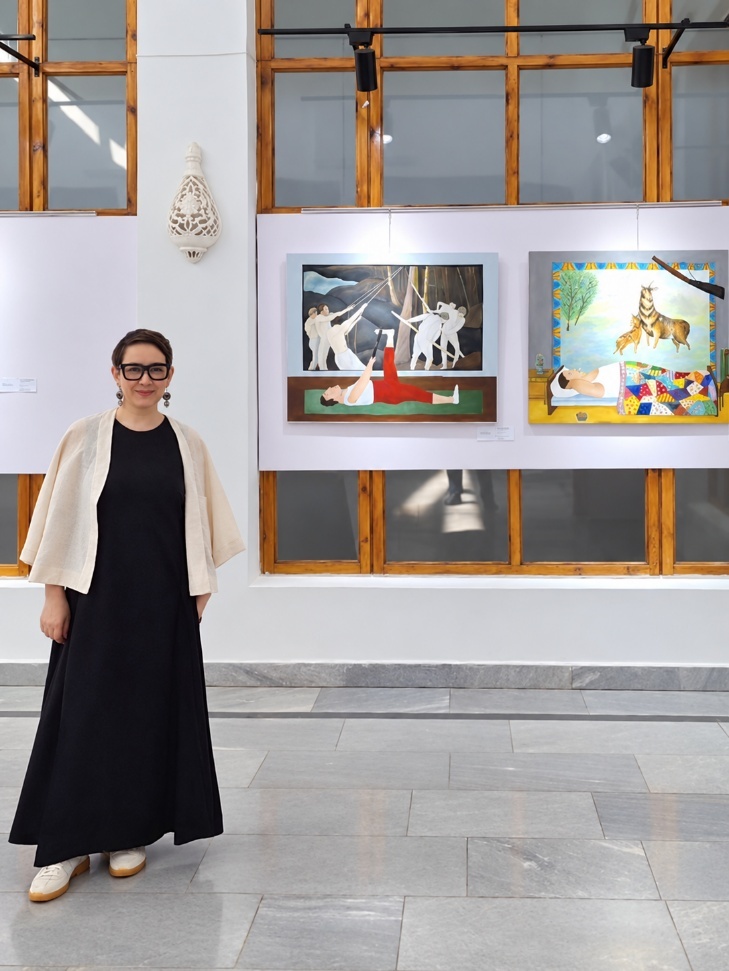
Uliana Novak with two paintings from her Carpets series at the XI Tashkent International Biennale of Contemporary Art, 2026.
In October 2026, I participated in the XI Tashkent International Biennale of Contemporary Art, Event Horizon, where I presented two paintings from my Carpets series. The trip offered an opportunity not only to share my work with an international audience, but also to encounter Uzbekistan's art scene and discover how artists from different countries approach questions of memory, cultural identity, and contemporary life.
Yet what stayed with me most was not only the artworks themselves, but the relationships between them, the institutions presenting them, and the people encountering them.
Before becoming an artist, I spent a significant part of my professional life in sociology and sociological research. This background continues to influence how I look at art. At the Biennale, I found myself observing not only the exhibitions, but also the spaces in which they took place, the conversations around them, and the ways artists and audiences interacted.
Gradually, these observations led me to a broader question: what makes an international biennale more than a large exhibition bringing together artists from different countries? Perhaps its significance lies not simply in the number of participants or the diversity of works, but in the encounters and new relationships it makes possible.
I would like to explore a few moments from Tashkent that made me think about this question. These are personal observations rather than a comprehensive assessment of the Biennale or Uzbekistan's art scene. What interests me is how different artistic traditions, institutional practices, and cultural experiences meet—and what happens when they do.
Different Artistic Languages
One of my first impressions was the strength of Uzbekistan's academic art tradition.
The Biennale featured many accomplished paintings and sculptures demonstrating technical mastery, sensitivity to materials, and a deep understanding of artistic form. At the same time, I noticed how differently the participating artists approached the relationship between artistic form, meaning, and the viewer. Some works relied primarily on the expressive possibilities of images, composition, and materials. Others developed their ideas through conceptual frameworks, research, personal narratives, or social and political contexts.
These approaches cannot be neatly divided into traditional and contemporary art. Conceptual thinking is not exclusive to installations or new media, just as painting and sculpture are not necessarily concerned only with representation or craftsmanship. Nevertheless, I sensed that different artistic languages were meeting at the Biennale without always entering into a dialogue with one another.
This became particularly interesting to me when looking at two works addressing cultural heritage in very different ways.
In The Great Silk Road, sculptor Anush Avakyan presented five white ceramic silkworm cocoons arranged vertically. Their smooth, repeated forms created a striking rhythm and a delicate sense of balance. The accompanying artist's statement connected the cocoons with Eastern cultural heritage, historical continuity, development, and broader social aspirations.
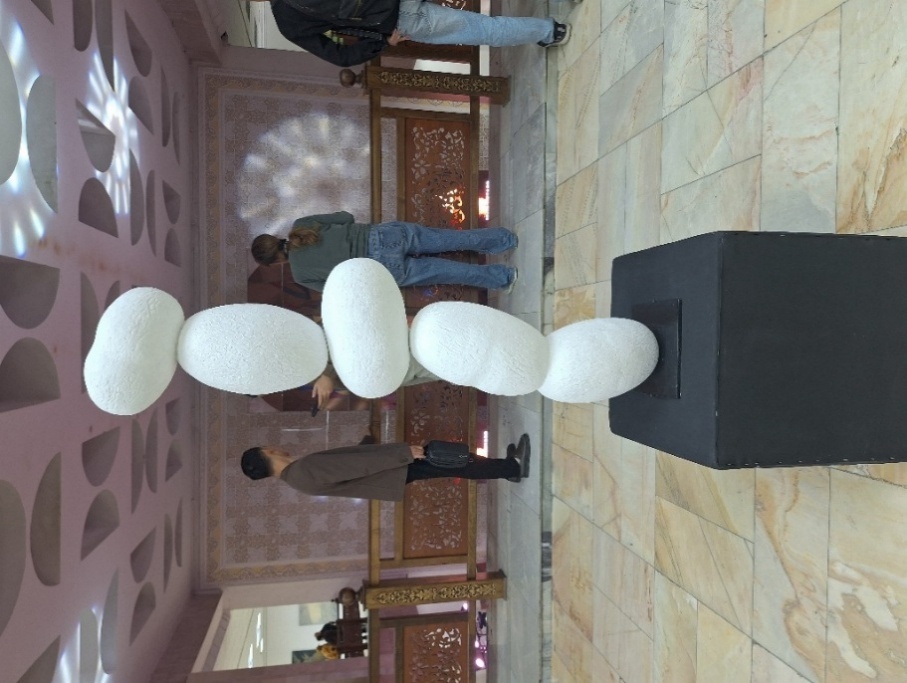
Anush Avakyan (Uzbekistan). “The Great Silk Road”.
I was interested in the relationship between the sculpture and its explanation. The statement introduced a wide range of social and cultural meanings, but I found it difficult to see how some of these ideas emerged from the work's artistic form. Without the accompanying text, many of these meanings would not have occurred to me.
Marina Borodina's installation Not an Old Town approached cultural heritage through a different visual language. It consisted of bricks arranged into a structure resembling a fragment of a building. The connection with architecture was immediately recognisable.
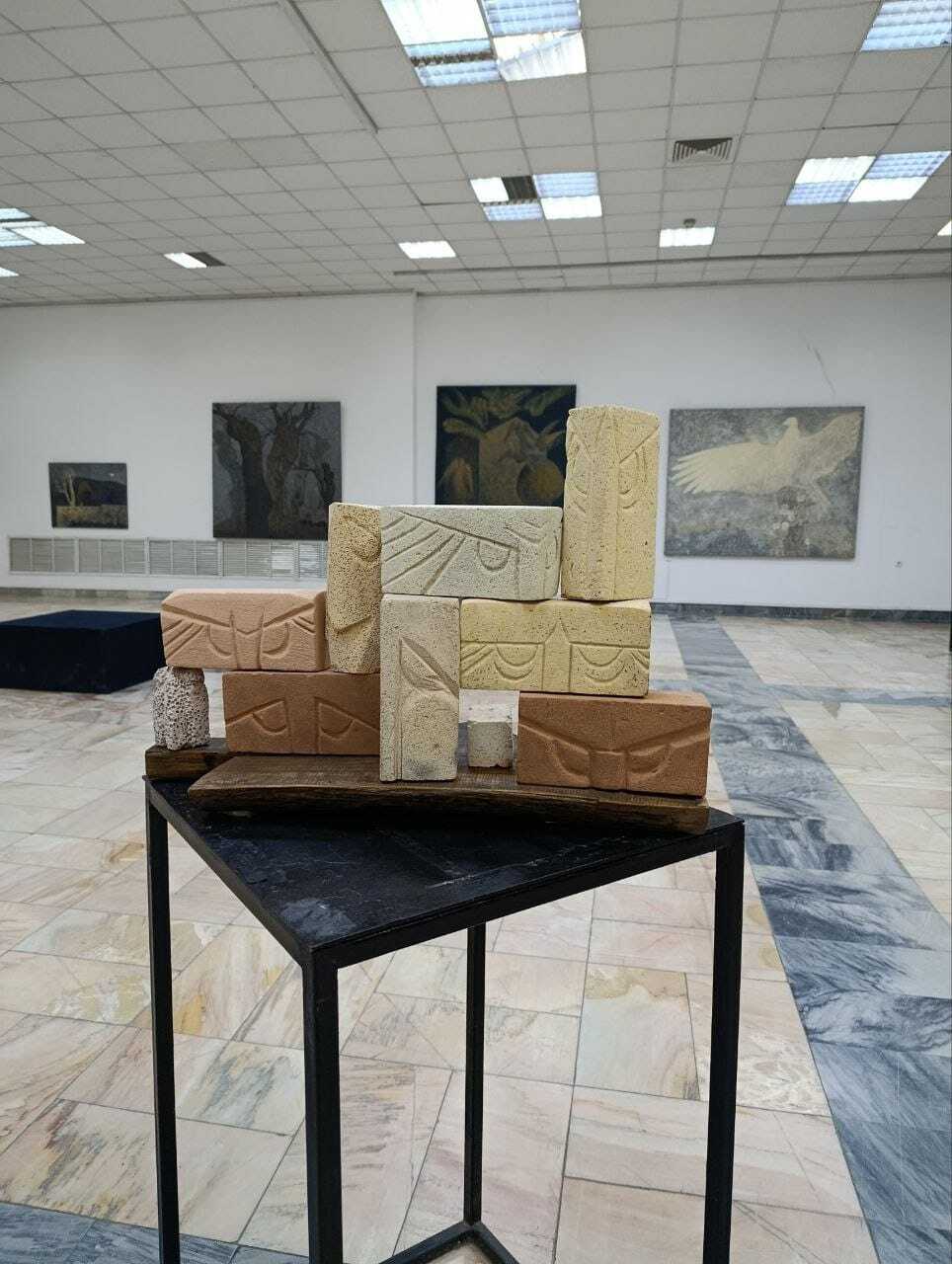
Marina Borodina (Uzbekistan). Installation “Not an Old Town”, bricks, 2026.
In conversation with the artist, I learned about her concern over the demolition of historic buildings in Tashkent's old town. Born and raised in the city, she had witnessed changes to a place that was part of her own life.
The conversation did not reveal hidden meanings in the installation. Rather, it helped me understand what had prompted the artist to create it: a personal connection to a particular place and concern about changes taking place in the city today.
These two encounters made me think about the different relationships that can exist between an artwork and its context. In one case, an extensive conceptual explanation introduced meanings that were difficult for me to recognise in the work itself. In the other, knowing the artist's personal and social circumstances helped me understand the origins of an artistic statement whose visual language was relatively direct.
I was interested in how differently artistic form, an artist's intentions, and the surrounding context could relate to one another—and how much of these relationships becomes accessible to a viewer encountering the work for the first time.
Between the Artwork and the Viewer
I remember the opening of an exhibition at the Art Gallery of Uzbekistan, one of the venues of the Biennale. It was stuffy inside, and some guests had stepped outside for fresh air. I joined them and happened to overhear a conversation among people who, judging by what they were saying, worked at the Academy.
Something about their conversations, their intonations, and the atmosphere suddenly transported me thirty years back into my own life, when I worked in a university environment. I almost physically recognised a world I had left long ago.
Then we went inside.
The exhibition hall presented works by contemporary artists from different countries, including installations that employed artistic languages quite different from those traditionally associated with academic art. I watched the visitors. Some examined the works with curiosity; others seemed uncertain about what they were looking at. "I'm not even going to look at that," I heard one woman say.
Naturally, one person's reaction cannot tell us how an entire artistic community responds to contemporary art. What interested me was the contrast between the familiar atmosphere of an established academic community and the diverse artistic practices presented inside the gallery.
An exhibition can bring different artistic traditions together physically, but what helps them enter into a meaningful dialogue? And what role does the institution play in making unfamiliar artistic languages accessible to audiences?
I also found myself struggling to understand some of the works.
This was true of both local and international participants. Some works were accompanied by detailed statements, while others had little or no explanatory information. For example, my two paintings from the Carpets series were displayed without accompanying text, although I had submitted one in advance.
After discussing the possibility of adding it with a representative of the organising committee, I began wondering whether different artistic media were being approached differently in terms of the contextual information provided to visitors.
Yet the conceptual content of an artwork is not determined by its medium. Behind an image of a carpet there may be an exploration of cultural memory, belonging, migration, and the relationship between a person's past and present.
I wanted to understand not only what I was seeing, but what lay behind it: the artist's questions, experiences, and cultural context. One work by a Chinese artist particularly caught my attention. I tried to find out more about its creator, but my searches on Google led nowhere. Eventually, I approached an interpreter accompanying the Chinese delegation. She explained that Google is not accessible in China, where other search engines are used, and tried searching for the artist in Chinese. Even with her help, I was unable to learn more.
The artwork had crossed national borders to reach an international audience, yet information about its creator remained inaccessible to me. I could look at the work and form my own interpretation, but my attempt to explore its context had reached a dead end.
At one of the Biennale dinners, however, I experienced almost the opposite situation. I happened to sit next to two fellow artists. We started talking, and I learned about the personal experiences and ideas behind their works—things I might never have discovered in the exhibition halls.
The contrast stayed with me. In one case, despite my efforts, I could not find the information I was looking for. In the other, an unexpected conversation opened a new perspective on works I had already seen. How much of our understanding of art depends on such circumstances?
I certainly do not believe that every artwork should come with instructions on how to understand it. The possibility of an independent encounter, without immediately being told what a work means, is essential. But I also value the opportunity to go further—to discover the artist's intentions, research, and cultural context if I choose to. Such information need not impose a single interpretation. It may instead enrich or even challenge our initial impressions.
At the Biennale, I sometimes missed precisely this possibility of continuing an encounter with a work that had caught my attention. This seems particularly important at international exhibitions, where artists and viewers bring different cultural backgrounds and experiences.
The Carpet as a Shared Cultural Image
One of the most unexpected discoveries for me was the recurring presence of the carpet.
Three women artists from Finland, Russia, and Belarus were working with this image, although in very different ways. All three were familiar with the cultural world in which carpets have long served not only as household objects, but also as carriers of memory, tradition, and a sense of home. The carpet has a particularly strong presence in Central Asian culture, while also occupying an important place in the domestic and visual memory of many people who grew up in the former Soviet Union.
For me, this made the coincidence especially interesting. In my Carpets series, the carpet is associated with memories of home, migration, cultural belonging, and the impossibility of restoring a former way of life. It is a recognisable cultural object that carries traces of the past into a changed present.
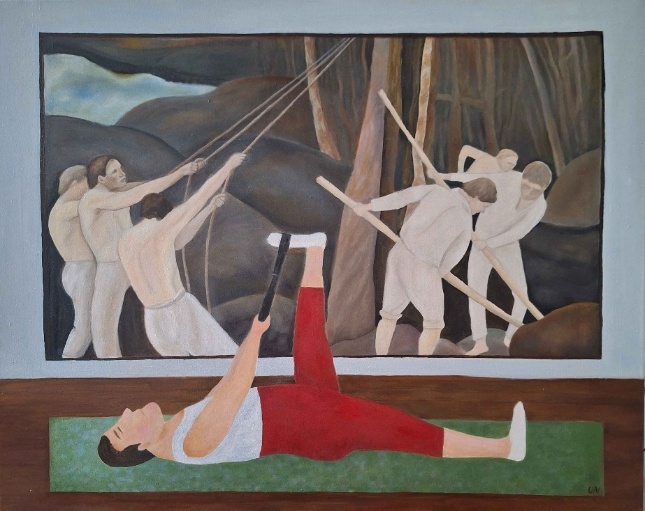
Uliana Novak (Finland). “Carpet #8”. Oil on canvas, 100 × 80 cm, 2025.
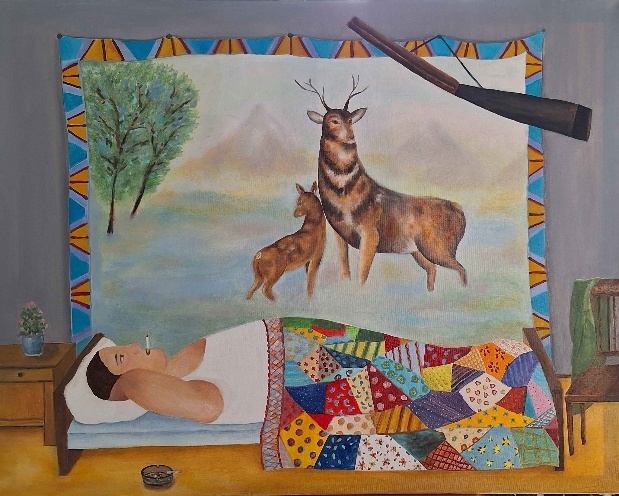
Uliana Novak (Finland). “Carpet #6”. Oil on canvas, 100 × 80 cm, 2025.
In Sofia Sokolinskaya's multimedia installation Carpets, traditional carpet patterns become a meeting point between human and machine memory. Personal and cultural histories intersect with digital imagery and algorithms, raising questions about how memory is transformed when it moves between material and technological forms.
In Anna Silivonchik's video art Data Dust, the carpet as a symbol of home, protection, and memory confronts images of destruction, displacement, and fragility. The title itself connects the material dust of the past with the apparent weightlessness of the digital world.
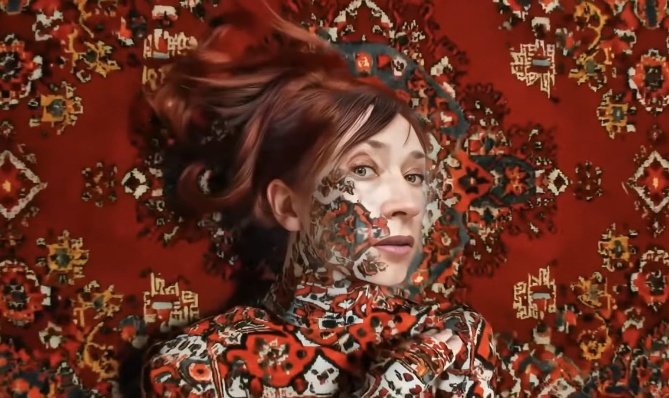
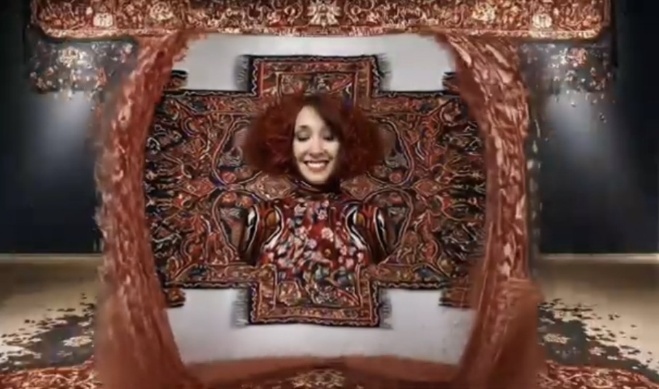
Anna Silivonchik (Belarus). “Data Dust”, video still from single-channel video, color, sound, Duration: 8:24
The same familiar object thus becomes a starting point for three different artistic investigations. What fascinated me was how an image rooted in everyday life could carry such varied meanings, shaped by personal experience, cultural memory, and changing technologies.
My paintings were exhibited in the same hall as Sokolinskaya's installation, which occupied a separate darkened space. Silivonchik's work was presented at another venue. I do not know whether this thematic relationship was part of the curatorial thinking behind the Biennale or an unexpected coincidence. But discovering it made me reflect on how connections between artworks emerge within a large exhibition.
Some relationships are deliberately established by artists and curators. Others are discovered by viewers as they move through the exhibition, bringing their own memories, knowledge, and experiences into what they see. In my mind, these three works began to form a conversation around a familiar cultural image, revealing different ways of thinking about memory, belonging, and change.
This discovery also returned me to my own work. The carpet, which I had brought into my paintings as a carrier of personal and cultural memory, appeared in Tashkent as part of a much wider conversation. What had begun as a personal artistic subject suddenly opened onto other histories, experiences, and ways of thinking.
What Makes a Biennale a Meeting Place?
The exhibition openings were lively and crowded, bringing together artists, Academy representatives, television crews, and guests. Official speeches, performances, and ceremonies gave the Biennale a distinctly formal and celebratory atmosphere, emphasising the importance of the event.
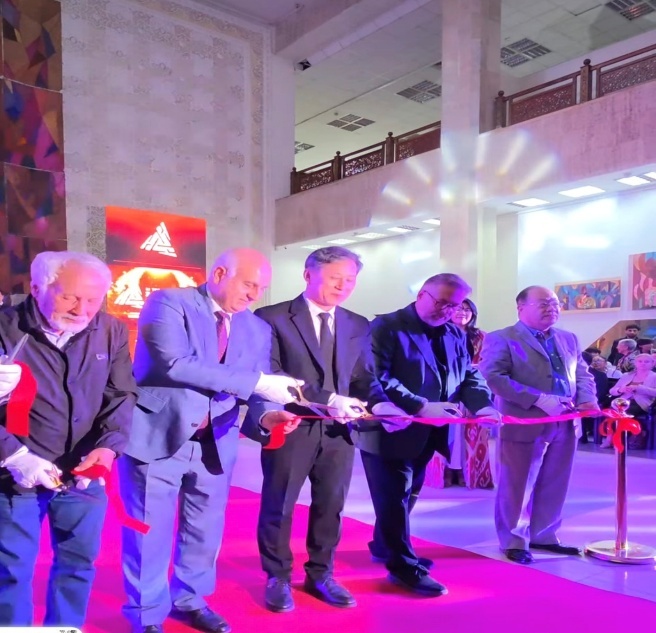
Official Opening Ceremony of the XI Tashkent International Biennale of Contemporary Art
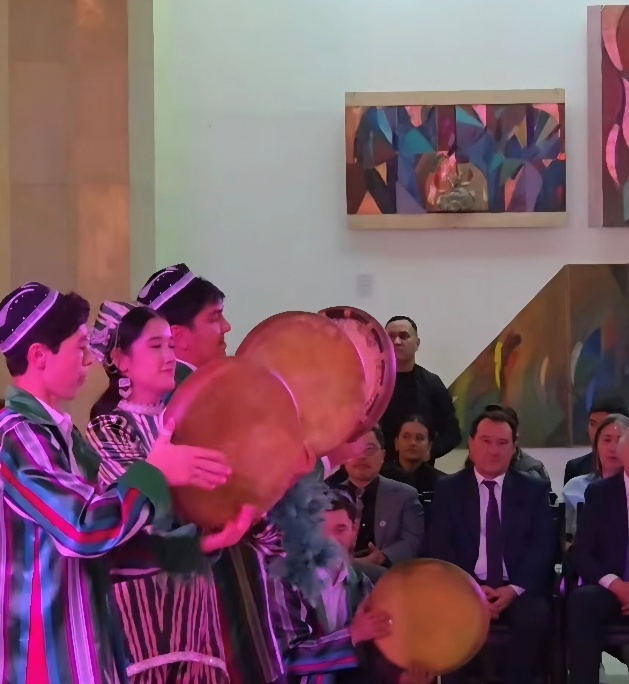
Musical Performance at the Opening Ceremony
I understood the significance of this public dimension. Yet amid the crowds and the succession of official events, I often wished for quieter conversations in which I could learn more about the artists and their work.
I had learned about my participation only a month before the opening, which left little time to establish contacts in advance. I do not know how other participants experienced the Biennale, but for me, these circumstances raised a question about the relationship between the public presentation of an international art event and the opportunities it creates for meaningful artistic exchange.
What, then, should an international biennale offer beyond bringing together artists from different countries? Perhaps its value lies not simply in its scale or the number of participating countries, but the relationships it helps create between artworks, artists, and viewers. Some of these connections arise unexpectedly; others depend on the conditions created by the organisers.
In this sense, bringing different artistic practices together is only the beginning. What matters is what becomes possible through their encounter.
Returning to the Event Horizon
All these observations made me reconsider the Biennale's theme, Event Horizon. I came to Tashkent with my Carpets - paintings about memory and a past that remains with us, even though returning to it is no longer possible. Unexpectedly, I encountered my own past.
Standing outside the Art Gallery of Uzbekistan, listening to familiar conversations, I suddenly felt again the atmosphere of university life that I had left many years earlier.
Then I entered the exhibition hall in a different role—as an artist participating in an international biennale.
Perhaps this is why my reflections on the encounter between different artistic traditions became so personal. I, too, have experienced a transition from one professional world to another, with different ideas about the value of work, different languages, and different ways of thinking.
And now I wonder whether, in Tashkent, I had encountered something of a similar process on an institutional level: an art institution with a long history negotiating its relationship with the changing world of contemporary art. I cannot know how this process will develop, or whether the tensions I sensed are understood in the same way by those working within the institution itself. But perhaps it was precisely this encounter between different artistic languages—languages that do not yet always fully understand one another—that became, for me, the most interesting manifestation of the event horizon to which the Biennale was dedicated.
← All writings/reflections